

Most floor cleaning companies do a fine job on tile, vinyl, and hardwood. But natural stone is a completely different material with different chemistry, and the standard cleaning approach can cause real damage. The problem is that most cleaners don’t know what they don’t know.
After 27 years of restoring marble, travertine, and granite floors across Tampa Bay, Marble Mechanics has seen the same preventable damage repeated in homes from South Tampa to Clearwater to Sarasota. These are the natural stone care tips that cleaning companies rarely share, either because they don’t know them or because the truth doesn’t fit a one-size-fits-all business model.
These 10 secrets can save you thousands in restoration costs and keep your stone looking the way it did when it was installed.
1. Your Floor Cleaner Probably Isn’t a Stone Expert
This is the most important secret on this list. Generic floor cleaning services train their teams on hard surfaces as a broad category: tile, vinyl, laminate, hardwood, and stone all get lumped together. But natural stone requires specific chemistry knowledge that most cleaning companies simply don’t teach.
Marble is calcium-based and reacts to acid. Granite is silica-based and handles acid fine. Travertine has natural pores that trap moisture differently than marble. Limestone is softer than all three. A cleaner who uses the same spray bottle on all of these isn’t being careless. They just weren’t trained to know the difference.
A stone restoration specialist uses diamond-impregnated pads, calibrated polishing compounds, and stone-specific sealers. A cleaning service uses an all-purpose spray and a mop. Both call it “floor care,” but they’re doing fundamentally different things.
The Difference That Matters
Cleaners are paid to remove dirt. Stone specialists are accountable for preserving the stone long-term. If your cleaning company can’t tell you the difference between honed and polished travertine, they probably shouldn’t be cleaning yours.
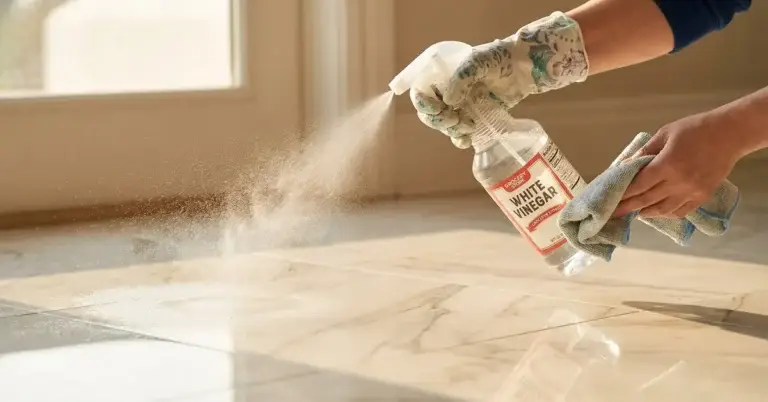
2. One Acidic Product Can Permanently Damage Your Stone
This isn’t a gradual process. One application of vinegar, lemon juice, or a citrus-based cleaner on marble or travertine leaves visible damage immediately. The acid reacts with the calcium carbonate in the stone’s surface and dissolves it, creating dull, cloudy marks called etch marks.
Etch marks are not stains. A stain sits on top of or inside the stone. An etch mark is actual surface damage where the stone’s finish has been chemically eaten away. You cannot clean an etch mark. You cannot seal over it. The only fix is professional honing with diamond abrasives.
Safe for Natural Stone
- pH-neutral stone cleaners (pH 7)
- Plain warm water
- Mild dish soap (sparingly)
- Microfiber cloths and mops
- Soft bristle broom for sweeping
Destroys Natural Stone
- Vinegar (any type)
- Lemon or citrus cleaners
- Bleach
- Ammonia-based products (Windex)
- Bathroom tile cleaners
- Grout cleaners with acid
A $3 bottle of vinegar can cause $400 or more in professional honing repairs. That math alone makes pH-neutral stone cleaners worth every penny. The Natural Stone Institute recommends pH-neutral cleaners as the only safe option for routine maintenance on calcareous stone.
3. Your Sealer Isn’t Permanent. It Expires.
Most homeowners think sealing their stone is a one-time job. It’s not. Sealers are impregnating chemicals that fill the stone’s pores and repel moisture. They don’t create a physical barrier on top of the stone. And they break down over time, especially under foot traffic.
In Tampa Bay’s climate, indoor sealers typically last 2 to 3 years. Outdoor sealers on pool decks and patios last 1 to 2 years. Florida’s humidity accelerates sealer breakdown because constant moisture cycles stress the chemical bonds.
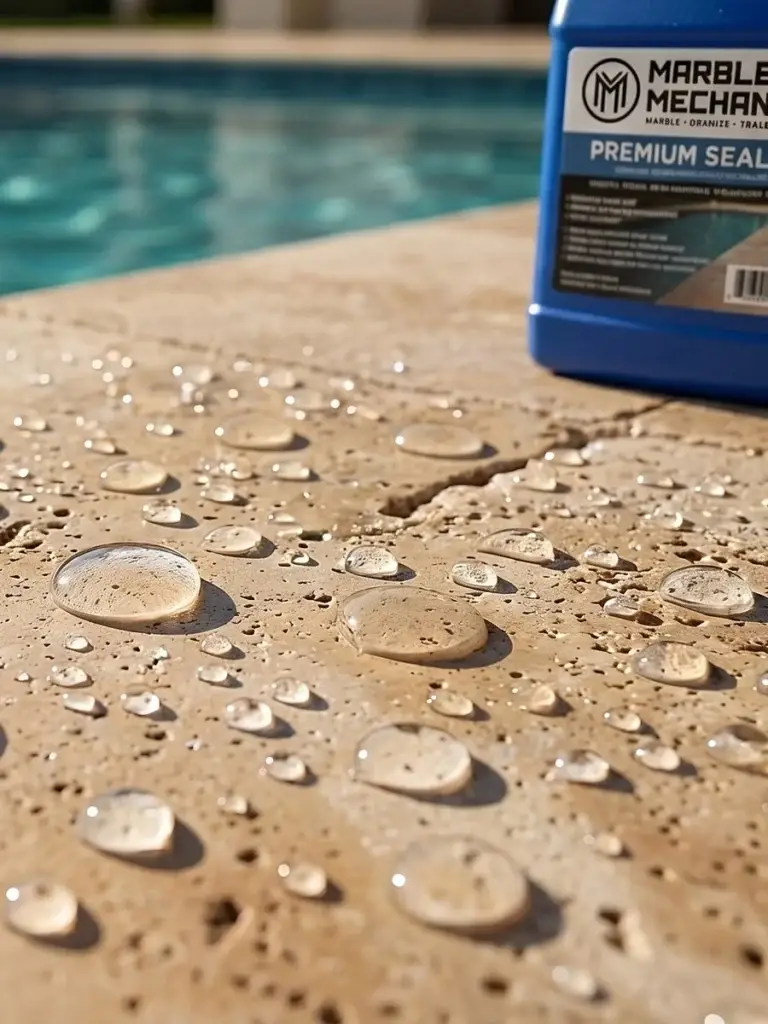
Quick Sealer Test
Place a few drops of water on your stone floor. If the water beads up, your sealer is working. If it absorbs and darkens the stone within 3 to 5 minutes, your sealer has worn off and the stone is unprotected. This takes 10 seconds and tells you everything you need to know.
Your cleaning company may never mention this because sealer testing and reapplication isn’t part of their service. But professional stone sealing matched to your specific stone type and environment is one of the best investments you can make for your floors.
4. Your Cleaning Service May Be Stripping Your Sealer Every Visit
Here’s a secret that even well-meaning cleaners don’t realize: many all-purpose cleaning products are slightly alkaline or acidic. Not enough to cause visible damage in a single use, but enough to degrade your sealer incrementally with every visit.
After six months of weekly cleaning with the wrong product, your sealer can be significantly compromised. You won’t see the damage until the day you spill coffee and it stains instantly, or you notice dull traffic patterns that weren’t there before.
Signs Your Cleaner May Be Damaging Your Stone
Stone stains more easily than it used to (sealer is gone)
Dull patches appear in high-traffic areas after cleaning
White or cloudy marks appear where liquid sat on the surface
The stone looks “tired” even right after it’s been cleaned
Your cleaner can’t name the specific product they use on your stone
If you hire any cleaning service for a home with natural stone, make it a requirement that they use only pH-neutral, stone-specific products. Put it in writing. Most will agree because neutral cleaners are available at the same price point as generic ones.
5. Sand and Dust Cause More Damage Than Liquid Spills
Tampa Bay homeowners worry about wine stains and coffee spills. Those are problems, but they’re not the biggest threat to your stone floors. Sand is.
Every grain of sand or dirt particle that gets tracked into your home acts like fine-grit sandpaper under foot traffic. Over weeks and months, thousands of micro-scratches accumulate across the surface. You see this as dull patches, loss of shine, or traffic patterns that no amount of mopping fixes.
In Tampa Bay, where beach sand, pool area grit, and outdoor dust are a daily reality, this problem is constant. Homes in Clearwater Beach, St. Pete Beach, Treasure Island, and Davis Islands deal with this more than anyone.
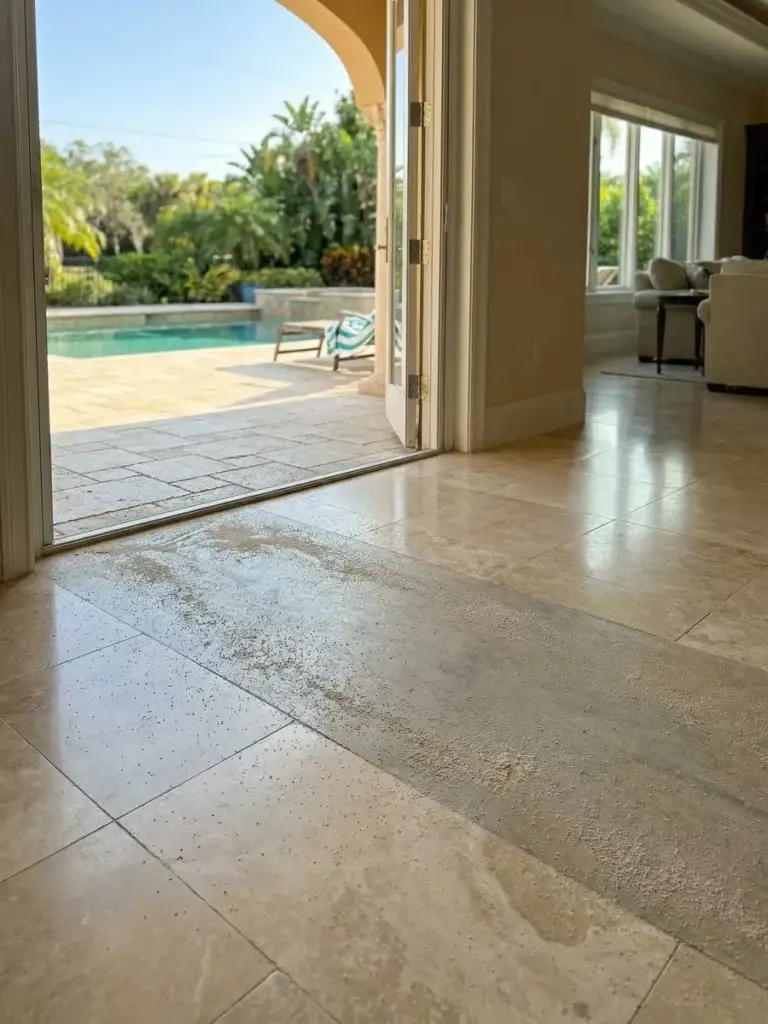
The One Rule That Prevents the Most Damage
Vacuum or dry mop before you wet mop. Every single time. If you only follow one natural stone care tip from this entire list, this is the one. Wet mopping over sand grinds the particles into the stone instead of removing them. Five minutes of dry sweeping prevents hundreds of dollars in future polishing.
Quality doormats at every entry point, removing shoes indoors, and daily dry mopping in high-traffic areas are the most cost-effective stone care habits you can have. They’re not glamorous, but they prevent the gradual dulling that eventually requires professional stone polishing to reverse.
6. Your Stone Type Changes Everything About How to Care for It
This is the secret that separates stone specialists from generic cleaners. Different natural stones have fundamentally different chemistry and require different care approaches.
Marble
Calcium-based. Reacts to any acid. Shows etch marks instantly from vinegar, citrus, or wine. Needs gentle pH-neutral cleaners only. Scratches more easily than granite. Most common in Tampa Bay foyers, bathrooms, and countertops.
Travertine
Limestone with natural holes and pits. Extremely porous. Absorbs liquids faster than marble. Fill material degrades over time, especially outdoors. Needs penetrating sealers. Tampa Bay’s most popular stone for pool decks and patios.
Granite
Silica-based. Much harder and more acid-resistant than marble. Handles most cleaners without etching. Still needs sealing to prevent staining. The most durable option for kitchen countertops and high-traffic floors.
A cleaner who uses the same product on all three of these stones is getting it right for one and potentially damaging two. Marble Mechanics sees this regularly in Tampa Bay homes where a cleaning service treats all stone the same way. The marble gets etched while the granite looks fine, and nobody connects the dots until the damage is visible. Knowing your specific stone type is the foundation of every other natural stone care tip on this list.
7. Florida’s Climate Attacks Your Stone in Ways Other States Don’t
National stone care guides don’t account for Tampa Bay’s specific combination of heat, humidity, salt air, and heavy rain. These factors create challenges that homeowners in drier climates never face.
Humidity degrades sealers faster. The constant moisture cycling between wet and dry seasons stresses sealer bonds. A sealer that lasts 3 years in Arizona may last 18 months in Tampa.
Salt air corrodes calcium-based stone. Homes near the coast in St. Pete Beach, Clearwater, Dunedin, and Siesta Key deal with salt crystallization that slowly eats into marble and limestone. This appears as white residue or gradual surface roughness that regular cleaning won’t fix.
Heavy rain overwhelms outdoor stone. Tampa Bay averages over 50 inches of rain per year, mostly between June and September. Outdoor travertine pool decks and patios absorb enormous amounts of water during this period. Without proper sealing, rainwater carries dirt, minerals, and organic material deep into the stone’s pores.
Mildew grows year-round. Florida’s humidity creates ideal conditions for mildew in shaded outdoor areas, bathroom travertine, and anywhere ventilation is limited. Mildew roots itself in the stone’s pores and can’t be removed with surface cleaning alone.
These are natural stone care tips specific to Florida that generic cleaning guides written for a national audience will never cover. If your cleaning company doesn’t adjust their approach for Tampa Bay’s climate, they’re using a playbook designed for a different environment.
8. The Cheapest Cleaning Service Will Cost You More Long-Term
This is the hardest secret to accept because it goes against every instinct to find the best deal. But the math is straightforward.
| Scenario | Annual Cost | 5-Year Total |
|---|---|---|
| Budget cleaner using generic products | ~$1,200/yr | $6,000 + $3,000 restoration |
| Stone-safe cleaner using proper products | ~$1,500/yr | $7,500 (no restoration needed) |
| DIY with right products + pro sealing every 2 yrs | ~$400/yr | $2,000 (best value) |
The budget cleaner saves $25 per visit but creates cumulative damage that requires a $2,000 to $5,000 professional restoration within 3 to 5 years. The stone-safe approach costs slightly more per visit but avoids restoration entirely. And the DIY approach with the right products and periodic professional sealing is the most cost-effective option of all.
Client Story: Bayshore Beautiful, Tampa
A homeowner with polished marble floors throughout their living area had used a weekly cleaning service for four years. The floors gradually lost their shine and developed dull traffic paths from the front door through the kitchen. Marble Mechanics was called to assess the damage. The sealer had been completely stripped by the cleaning products, and the surface had hundreds of micro-scratches from sand ground in during wet mopping. The full restoration took two days and cost more than the homeowner had spent on cleaning services in an entire year. Proper product selection from day one would have prevented the entire problem.
9. Not Every Problem Needs a Professional (But Some Absolutely Do)
Stone care companies, including Marble Mechanics, make their living from restoration services. So here’s the honest truth: many stone issues can be handled at home if you know what you’re doing.
You can handle at home: daily sweeping, weekly mopping with pH-neutral cleaner, blotting spills immediately, applying a poultice for surface stains (baking soda paste for oil-based stains, hydrogen peroxide paste for organic stains), and minor resealing of small areas.
You need a professional for: etch marks and dull spots from acidic damage, deep scratches and traffic wear patterns, widespread sealer failure, lippage (uneven tiles), fill material falling out of travertine, and any honing or polishing work that requires diamond abrasives.
The key is knowing which category your problem falls into. A stone surface assessment can determine whether you need professional intervention or just better daily habits. Oscar Tineo and the Marble Mechanics team offer free assessments across Tampa Bay for exactly this reason. Sometimes the best service a restoration company can provide is telling you that you don’t need one.
10. Prevention Costs a Fraction of Restoration
Every natural stone care tip in this article points to the same conclusion: preventing damage is dramatically cheaper than fixing it. Here’s what prevention actually looks like for a Tampa Bay homeowner:
- Doormats at every entry catch sand before it reaches your stone. Cost: $30 each. Savings: thousands in avoided polishing.
- pH-neutral stone cleaner instead of generic products. Cost: $20 per bottle. Savings: your entire sealer investment.
- Felt pads under furniture prevent scratches every time a chair moves. Cost: $10 per pack. Savings: localized honing repairs.
- Professional sealing every 2 to 3 years keeps moisture and stains out. Cost: $1.50 to $3.00 per square foot. Savings: full restoration at $3 to $6 per square foot.
- Runners in high-traffic corridors take the wear so your stone doesn’t. Cost: $50 to $200. Savings: years of additional life before refinishing.
The Natural Stone Institute notes that natural stone is one of the longest-lasting flooring materials available when properly maintained. Homeowners who invest in prevention consistently avoid the expensive restoration cycle that catches others off guard.
These aren’t luxury precautions. They’re basic natural stone care tips that save real money. The homeowners in Palma Ceia, Hyde Park, Westchase, and New Tampa who follow them rarely need restoration services. The ones who skip them become our most frequent clients.
Natural Stone Care Tips FAQ
Can a regular cleaning company safely clean natural stone floors?
Yes, if they use pH-neutral, stone-specific products and you verify this before hiring. Ask what exact product they use on stone surfaces. If they can’t name it or it’s a generic all-purpose cleaner, they’re likely causing gradual damage. Require stone-safe products in your service agreement.
How do I know if my stone floor has been damaged by the wrong cleaner?
Look for dull spots that don’t improve with cleaning, white or cloudy marks where liquids have sat, loss of shine in high-traffic areas, and stone that stains more easily than it used to. These are signs of etch damage or sealer degradation. A professional assessment can confirm whether the damage requires restoration or just resealing.
What should I look for when hiring a stone floor cleaning service?
Ask three questions: What specific product do you use on natural stone? Can you tell me the difference between marble and travertine care? Do you carry stone-specific products or use the same cleaner on all surfaces? A qualified service will answer all three confidently. If they hesitate or give vague answers, they’re a general cleaner, not a stone specialist.
Is steam cleaning safe for natural stone?
Steam cleaning is generally not recommended for natural stone, especially sealed stone. The high heat can break down sealer bonds, and the moisture can penetrate porous stones like travertine. For sealed marble or granite in good condition, occasional light steam cleaning may be acceptable, but it should never replace regular pH-neutral mopping. When in doubt, skip the steam and stick with warm water and a stone-safe cleaner.
Why does my stone floor look dull even after cleaning?
If your stone looks dull right after cleaning, the issue isn’t dirt. It’s either etch damage from acidic cleaning products (the surface finish has been chemically eaten away) or micro-scratches from sand and grit being ground into the surface during mopping. Both require professional honing to restore the finish. No amount of cleaning will fix surface damage.
Can I use the same cleaner on marble and granite?
A pH-neutral stone cleaner works safely on both. However, granite can tolerate slightly acidic or alkaline products that would damage marble. The safest approach is to use pH-neutral products on all natural stone. This eliminates the risk of accidentally using the wrong product on the wrong surface, especially in homes that have multiple stone types.
How much does it cost to fix stone damaged by the wrong cleaning products?
Professional honing and repolishing typically costs $3 to $6 per square foot, depending on the severity of the damage and the stone type. For a typical 300-square-foot living room, that’s $900 to $1,800. Severe damage requiring diamond grinding can cost more. Prevention with the right cleaning products costs less than $100 per year.
What is the safest daily cleaning routine for natural stone floors?
Dry sweep or vacuum first to remove sand and grit. Then damp mop with warm water and a pH-neutral stone cleaner. Use a clean microfiber mop, and change the water when it gets dirty. Blot spills immediately rather than wiping them. That’s it. Natural stone doesn’t need complicated routines. It needs the right products and consistency.
Tampa Bay Service Areas
Marble Mechanics provides natural stone restoration, maintenance, and sealing services throughout Tampa Bay, including Tampa, South Tampa, Hyde Park, Davis Islands, Palma Ceia, Bayshore Beautiful, Westchase, Carrollwood, New Tampa, Brandon, Riverview, Valrico, Wesley Chapel, Lutz, Temple Terrace, St. Petersburg, Clearwater, Largo, Palm Harbor, Dunedin, Tarpon Springs, Safety Harbor, Seminole, Treasure Island, St. Pete Beach, Bradenton, Sarasota, Lakewood Ranch, Siesta Key, Longboat Key, and surrounding communities across Hillsborough, Pinellas, Pasco, Manatee, and Sarasota counties.
Not Sure if Your Stone Has Been Damaged by the Wrong Products?
Marble Mechanics offers free stone assessments across Tampa Bay. We’ll tell you exactly what your floors need.
Written by Oscar Tineo, Founder of Marble Mechanics, with 27+ years of stone restoration experience in Tampa Bay. These natural stone care tips come from restoring thousands of floors across the region. Call 813-625-3377 or visit marblemechanics.com.
Related reading: Travertine Maintenance Guide for Tampa Bay Homeowners | Saltillo Tile Restoration Tampa Bay